
Reviewed · JEWISH HERITAGE TOURS
Jewish Heritage in Hungary with a Historian
Budapest’s Jewish story is layered, and this street-by-street tour turns big, sometimes heavy topics into scenes you can point at, starting around Erzsébet tér and running through the Jewish Quarter. A historian guides the narrative so the landmarks feel connected, not random.
I especially like the small group size (up to 10), which makes it easier to ask questions and get answers that fit your pace. I also like the balance between commemoration and everyday culture, including Flódni at Solinfo Café (included).
One drawback to plan for: synagogue admission is not included for key stops like Kazinczy Street Synagogue and the Great/Central Synagogue is not entered, so you will be looking from outside.
Key things that make this tour worth your time
- Up to 10 people so the historian can respond in a real back-and-forth way
- Historian-led focus that connects centuries, not just the 1940s
- Szimpla Kert ruin bar stop linked to how Budapest reuses older buildings
- Raoul Wallenberg’s statue gives you a clear anchor for stories of rescue
- Flódni at Solinfo Café is included, so you taste the local Jewish food culture
- Major synagogue stops are mostly exterior, since some tickets are not included
Jewish Heritage in Budapest, explained where the stories still live
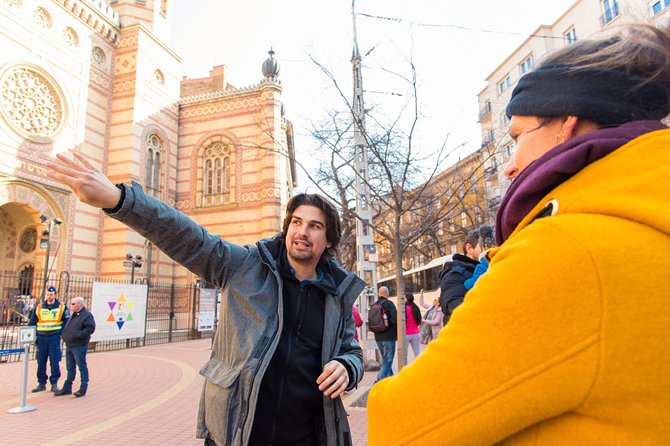
Budapest has a knack for making history visible. Stone, street names, and a few famous buildings carry the memory of what happened here, and what changed over time. This tour leans into that. You walk with a historian and you learn how the Jewish community shaped Budapest, long before the modern era, and how the city changed in response to Jewish life, repression, and survival.
The tone stays human. You are not just hearing dates. You are getting context for why neighborhoods look the way they do, why certain streets became known, and why some places are still emotionally charged. In the small-group setting, that makes a big difference.
You also get practical variety. There is a serious portion near historic sites, then a quick breather at Szimpla Kert, and a food moment that is genuinely part of local culture, not just an afterthought.
More Jewish heritage and synagogue tours in Budapest:
- Budapest Jewish Heritage Memorial Walking Tour & Synagogue Entry
★ 5.0 · 568 reviews - Budapest: Jewish Heritage Guided Tour with Synagogue Ticket
★ 4.8 · 533 reviews - Walking Tour Budapest incl. the Shoes on the Danube Bank
★ 5.0 · 387 reviews
What $64.71 buys you in 2.5 hours
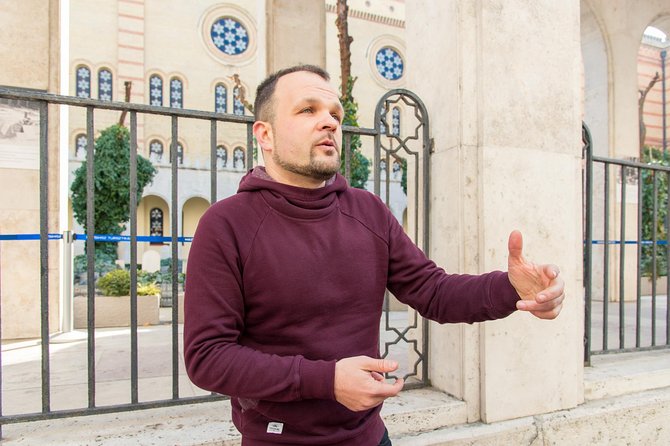
At about $64.71 per person for roughly 2 hours 30 minutes, the value here is not “see more in less time.” It is how the time is shaped. You get a compact route that hits major reference points in the Jewish District area: key squares, major Jewish sites, and one of Budapest’s iconic re-use stories in the form of Szimpla Kert.
Also, the tour is offered in English, starts at 10:00 am, and uses a mobile ticket, which keeps the whole thing simple on the day. And since the group is capped at 10, you avoid the feeling that you are just being streamed past monuments.
If you are expecting the price to include entry into every synagogue, adjust your expectations. Admission tickets for Kazinczy Street Synagogue and the Great/Central Synagogue are not included, and you do not go inside the Great Synagogue.
From Kempinski Hotel Corvinus to the Jewish Quarter, with a timed flow
The tour starts at Kempinski Hotel Corvinus Budapest on Erzsébet tér 7-8. Ending point is outside Dohány Street Synagogue at Wesselényi utca 1. That end location is useful, because it gives you an easy way to connect to whatever you want next, including more time in the area.
The pacing is built from short stops. You get around 10 to 20 minutes at several points, and one longer segment at the Great/Central Synagogue area. That matters because the Jewish Quarter can feel dense and emotional. Short segments keep you oriented, and they also let you ask questions without the guide talking over you.
Because the tour is near public transportation and has a confirmed start, it is also a good option if you do not want to plan a long self-guided loop.
Erzsébet tér: the medieval square that now holds modern Pest
Your walk begins at Erzsébet tér, a square that started as a medieval market area and has become one of the main squares of Pest. This is a smart opening because it grounds you in the geography of Budapest before you get into the more specific Jewish landmarks.
What I like about starting here is that it helps you understand the city as a living place. You are not only learning about a community tucked into one pocket. You are seeing how Jewish life connected to broader Pest, through streets and public spaces that people actually moved through.
This stop is short, about 20 minutes, and the admission is free. It is the kind of start that helps you get your bearings fast.
More history-led tours in Budapest:
- Budapest: Historic Cruise with Welcome Drink
★ 4.7 · 6,512 reviews - Budapest Historical Sightseeing – Free Walking Tour
★ 5.0 · 1,302 reviews - Buda Castle District Dark History, Legends and Vampire Night Tour
★ 4.5 · 1,240 reviews - BloodThirsty Hungary: Walking tour & Dark Historical Stories
★ 4.9 · 633 reviews
Raoul Wallenberg’s statue: a rescue story you can stand in front of
Next is Raoul Wallenberg’s statue, with about 10 minutes there. This is one of those moments where the city gives you a clear moral anchor. Even if you know the name, seeing the statue in place makes the story feel less like a distant chapter and more like a visible part of Budapest’s memory.
This stop is quick, but it is not empty. It gives you a lens for interpreting what you see later: the difference between persecution and survival, between loss and action, and between people acting inside history instead of watching history happen to them.
Admission is free, so you can focus entirely on the explanation and the questions.
Szimpla Kert ruin bar: old buildings, new use, and the city’s creative edge
Then you hit Szimpla Kert, a ruin bar that helped kick off the trend. This is one of Budapest’s fun contrasts: you are standing in a space born from reuse, not from new construction.
The tour frames it through the broader lens of how the city changes. Ruin bars are not just nightlife. They are also a sign of how people adapt, how neighborhoods get reimagined, and how once-neglected spaces can return to public life.
You get around 20 minutes here, and the admission is free. For me, this stop is valuable because it keeps the overall day from turning into a single mood. You still carry the context from the historian, but you also see Budapest as it is lived today.
Gozsdu Udvar: an international street scene in miniature
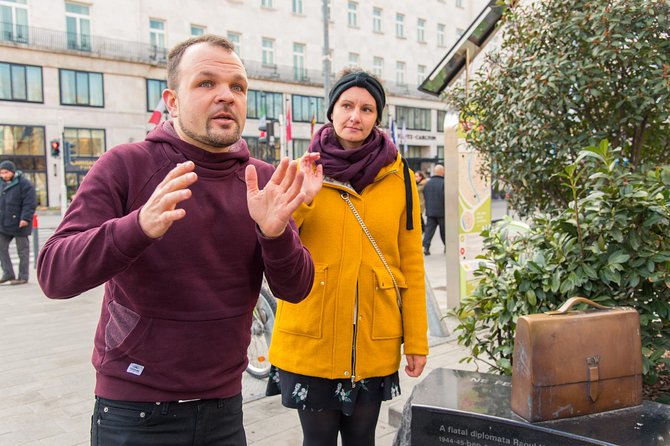
After Szimpla Kert, you spend about 10 minutes at Gozsdu Udvar, described as one of Budapest’s most international streets. This is a useful connective stop. It shows how the Jewish Quarter area is not sealed off as a museum district.
If you plan to keep exploring after the tour ends, this stop can help you spot the vibe of the area: more movement, more languages, more casual life in the streets.
Admission is listed as free for this stop. It is more about orientation than ticketed sights.
Kazinczy Street Synagogue: the Orthodox Jewish community, up close from the street
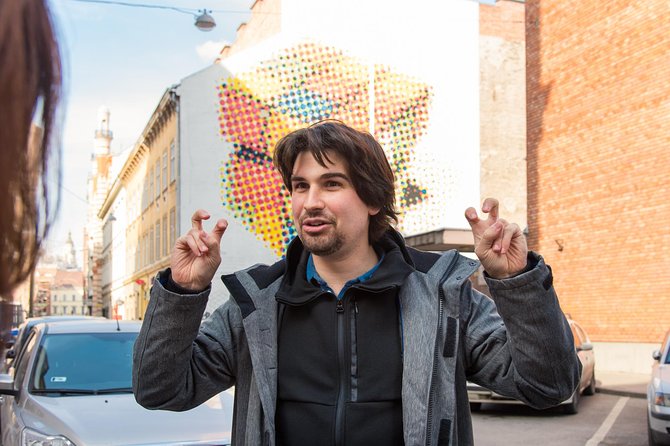
At Kazinczy Street Synagogue, you get about 20 minutes to learn about the Orthodox Jewish community. This is one of the key moments where you move from “Budapest in general” to a more specific understanding of how Orthodox life shaped community presence in the city.
Important practical note: admission is not included for this synagogue stop. So even though you learn and you likely get views from outside or at least through areas where the tour takes you, you should not assume you can just walk in for the price of the tour.
This is also where I recommend you bring your questions. A guide can explain terms and community structure in a way that self-guided browsing rarely captures. The best part of a historian-led format is that the explanations can connect to what you will see later at the larger synagogue sites.
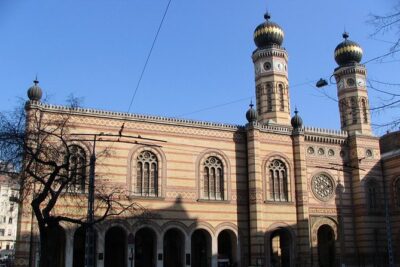
The Great/Central Synagogue (Nagy Zsinagoga): huge, historic, and viewed without entry
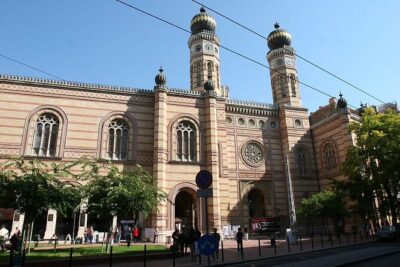
The tour then spends about 45 minutes on the Great/Central Synagogue (Nagy Zsinagoga). This is Europe’s largest synagogue, and the building carries a strong set of historical associations from roughly the last 200 years.
You should know this ahead of time: you do not visit the Great Synagogue inside. The stop is about learning what the synagogue represents and why it matters to Budapest’s Jewish story, from architecture and symbolism to community life in changing times.
Admission for this stop is also not included. So if you want the interior, you will need to plan separate entry on your own after the tour, or choose another experience that includes it.
Even without going inside, I think this is still worth the time. A big exterior landmark like this is easier to “read” in context once you have already heard the story of the neighborhood’s development and the community’s shifts over centuries.
Solinfo Café and Flódni: the included taste of Jewish Budapest
You end with a food stop at Solinfo Café and you try Flódni, a local Jewish cake. Admission is listed as included, and you spend about 20 minutes here.
This is not just dessert. Flódni is one of those foods that becomes a shortcut to culture. When you taste it, you understand that Jewish heritage is not only memorial and tragedy. It is also daily life, recipes passed along, and food that belongs to normal people in normal routines.
If you are the type who usually skips food tours, do not skip this one. It is timed well, and it is directly connected to local Jewish culture rather than being a random snack. It is also a good moment to regroup emotionally after synagogue-heavy parts of the walk.
The historian factor: what you get that a guidebook will not
The biggest reason I would choose this format is the historian lens. Several guides on similar tours are good at spotting landmarks. A historian approach is different. It focuses on how events connect across time, and it tends to include both the hard parts and the wider story of Jewish life.
In particular, this tour’s framing is designed to show that Budapest’s Jewish heritage is not only the Holocaust. You get coverage that stretches back centuries, then moves through later eras with honesty about what happened and what changed.
That balance matters. If you only hear about the most tragic period, you lose the full meaning of the community’s presence before and after. If you only hear about the beautiful parts, you miss what people endured. This tour aims for the middle path, with room for questions in the small group.
Who should book this Jewish heritage walk
This works best if you:
- want a small-group experience with up to 10 people
- like walking tours but do not want a sprint through 20 stops
- want a historian-guided explanation focused on real context
- care about more than one slice of Jewish history, not just one era
- enjoy practical city stops like Szimpla Kert and a real food taste like Flódni
It is also a good fit if you plan to spend more time around Dohány Street Synagogue after the tour ends, since you finish nearby.
If you strongly prefer a tour that includes interior synagogue visits for paid attractions, you might want to look at options that explicitly include entries. Here, the Great Synagogue is not entered, and admission for Kazinczy is not included.
Should you book this tour?
I think it is a smart booking for first-timers who want Jewish heritage in Budapest without drowning in a long day. The 2.5-hour length, English format, and small group cap help keep it focused. The added food moment at Solinfo Café, with Flódni included, makes it memorable in a way history-only tours rarely do.
Book it if you want the story connected to what you see on the streets, with a historian guiding you through centuries and not just headlines. Skip or plan ahead for extra tickets if you specifically need inside access to every synagogue.
FAQ
What language is the tour offered in?
The tour is offered in English.
How long is the Jewish Heritage in Hungary tour?
It runs for about 2 hours 30 minutes.
How big is the group?
The tour has a maximum of 10 travelers, keeping it small-group and intimate.
Is synagogue admission included?
Admission tickets are not included for Kazinczy Street Synagogue and the Great/Central Synagogue (Nagy Zsinagoga). The tour also notes that you do not visit the Great Synagogue inside.
Is the Flódni cake included?
Yes. You try Flódni at Solinfo Café, and admission is included for that stop.
Where do you start and where do you end?
You start at Kempinski Hotel Corvinus Budapest, Erzsébet tér 7-8, 1051 Hungary. You end outside Dohány Street Synagogue at Wesselényi utca 1, 1077 Hungary.
Is there free cancellation?
Yes. You can cancel for a full refund up to 24 hours in advance of the experience start time.
Recently reviewed around Budapest
- Panoramic hike around Budapest★ 5.0 · 14 reviews
- PRIVATE (7 hours) Budapest and Szentendre city tour with lunch and winetasting★ 5.0 · 4 reviews
- Original Budapest Walking Tour★ 4.0 · 39 reviews
- Budapest Highlights Self guided scavenger hunt and Walking Tour★ 5.0 · 5 reviews
- Hungarian Gastro Cellar: Assisted Tasting Options★ 4.5 · 5 reviews
- Original Budapest Alternative Street Art & Jewish Tour★ 4.5 · 14 reviews
- One hour Hen or Stag private party boat Budapest with unlimited beer and wine★ 3.5 · 6 reviews
- Bratislava, one day private trip from Budapest with guide!★ 5.0 · 4 reviews
Jewish Heritage Tours, compared.
Budapest Jewish Heritage Memorial Walking Tour & Synagogue Entry
Read our review →
Jewish Heritage Guided Tour with Synagogue Ticket
Read our review →
Walking Tour Budapest incl. the Shoes on the Danube Bank
Read our review →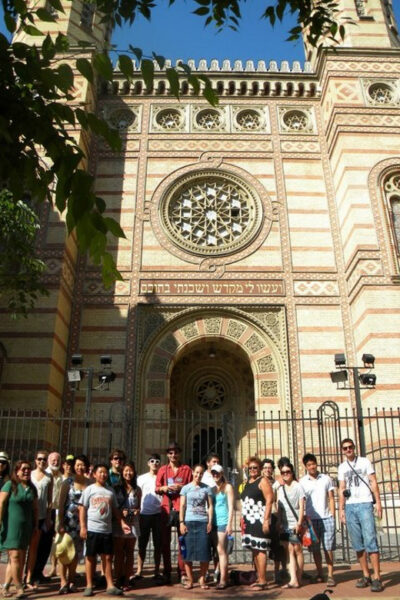
Past and Present of Budapest Jewish District Tour
Read our review →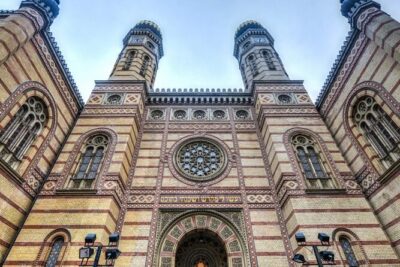
Budapest Dohany Synagogue & Hungarian Jewish Museum & free extras
Read our review →Browse the lists this tour appears in