
Reviewed · BUDAPEST
Hungary today: a no-taboo conversation
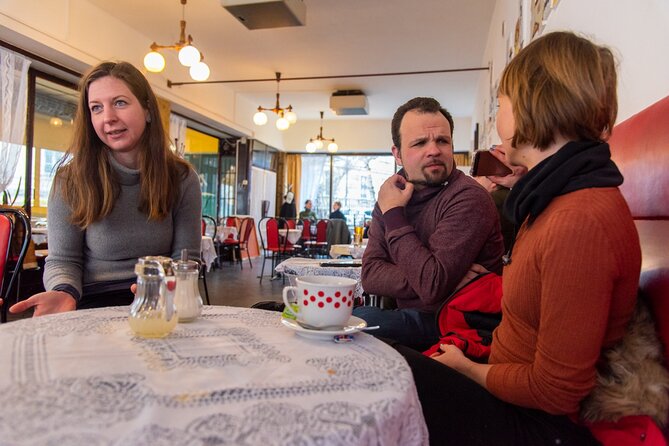
What makes this experience interesting is the format: a no-taboo conversation that tackles modern Hungary head on, without pretending politics is too boring to talk about. You start in a cafe that feels like a time capsule, then move into real talk about the shift from communism to democracy, and the newer idea often described as illiberal democracy. It’s Budapest today, not a museum script, and you steer the questions.
I love how small the group is, up to 6 people, because it makes the conversation easier to join and harder to hide from. I also like that the host, Daniel, offers an honest first chapter on the last 30 years, then lets you ask anything you want, including the controversial stuff. One possible drawback is that this is not a sightseeing tour. If you want lots of photo stops or fixed points of interest, this might feel too conversation-led.
Key things to know before you go

- Up to 6 guests keeps it conversational, not lecture-like
- Bambi Café is the starting point, a cult cafe with an almost unchanged feel since the 1970s
- Modern Hungary focus includes the last 30 years, with political and economic angles
- You drive the questions after an introductory segment
- Mobile ticket for a simple start
- Price is aimed at the discussion rather than added attractions
A candid Hungary Today chat, not a scripted lecture
If you’ve ever sat through a tour where the guide says interesting things but never really answers the questions you actually have, you’ll understand why this works. The whole point is a conversation you can push toward the topics that make you curious, uneasy, or just plain confused.
In the first part, the host sets the stage with facts and their opinion on Hungary’s recent past and present. You’re looking at how the country moved from communism toward democracy, and how politics has evolved in recent years in ways people describe as illiberal democracy. That gives you a framework, so your later questions are grounded, not random.
Then it becomes Q and A in the truest sense. You can ask about controversial politics, a turbulent past, the uncertain future, or the economy. And if you do not have exact questions, you still get a structured introduction to the modern era, so you do not walk in blank.
This is also why the small group matters. With only a few people, you’re more likely to get a real back-and-forth, not a one-way talk.
Other things people book in Budapest:
- Budapest: City Highlights Cruise with Welcome Drink
★ 4.6 · 35,610 reviews - Budapest: Unlimited Prosecco, Beer and Aperol Spritz Cruise
★ 4.8 · 25,310 reviews - Budapest: Széchenyi Spa Day Ticket with Optional Upgrades
★ 4.3 · 23,911 reviews
Starting at Bambi Café, a Budapest time capsule
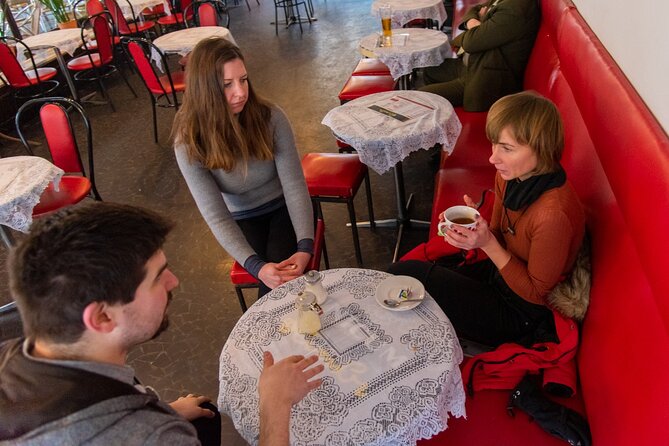
You meet at Bambi Café, at Frankel Leó út 2-4 in Budapest. This is not the kind of meeting point that feels like a quick “let’s assemble” location. It’s a cult cafe, and the vibe is described as having changed close to none since the 1970s.
That detail matters more than it sounds. Places that keep their character over decades give you something to look at while you wait, and they set a tone. Instead of stepping into a modern lecture room, you start in an environment that feels historically anchored. It’s a small but smart way to make the conversation feel connected to everyday life, not just headlines.
Also, the stop itself includes a free admission ticket for this portion. So you’re not paying extra to be there, and you’re not stacking a bunch of paid add-ons on top of the experience.
One practical note: this is an urban stop, so wear what you’d normally wear for walking in central Budapest. And if you plan to arrive early, take a minute to just notice what has stayed consistent. It will help your brain shift from tourist mode to conversation mode.
The real flow: intro facts, then your questions
The experience runs about 1 hour 30 minutes. It’s long enough to cover context, but short enough that the tone stays focused and interactive.
Here is how the structure typically feels:
1) A modern-era introduction focused on historical, economical, and political aspects, mainly centered on the last 30 years.
2) A Q and A conversation where you can steer. You can go controversial or practical. You can ask about politics, but also about what those changes mean for daily life and where things might go next.
That two-part design is the value. Many tours give you either context or conversation. This gives you both, with the second part tied directly to your curiosity.
In the reviews, people highlight that the conversation reaches beyond “their country” and touches the world as well. One guest described it as the best experience of their Budapest week, praising the depth of knowledge of not only Hungary but also global issues. Another said the discussion was ideal if you’ve already been to Budapest and you want more than the basic modern-history outline.
And that lines up with what I think the format is really doing. It turns your visit into a two-way exchange. You leave with a better sense of how a Hungarian person thinks about their country now, and not just a summary of events.
Why the communism to democracy story still matters
You might think modern Hungary is something you either learn in a textbook or you skip because it feels heavy. The host’s approach keeps it grounded: how Hungary changed from communism to democracy, and why later political developments raised concerns and debate.
The conversation specifically includes the idea of illiberal democracy, discussed as something that has been created in the past few years. That phrase can sound abstract until you connect it to real questions: What gets traded off? Who feels the impact first? How do people interpret institutions, elections, and checks and balances?
The best part of this type of intro is that it is not delivered like a debate club. It’s framed as facts plus opinion, and then you get to ask what you want. If you agree with the host, you get the reasoning. If you disagree, you get a chance to challenge ideas respectfully and hear a different view.
This is also a good fit if you worry about getting things wrong. Instead of relying on random bits you pick up on the internet, you can ask a direct question. You can also ask for clarification on terms and themes, especially if you have heard different interpretations and want a clearer picture.
Just remember: this is politics and society. If you’re looking for neutral, sanitized travel content only, you may find it too real. But if you want to understand Hungary as a living place, this approach makes sense.
A different way to spend a day in Budapest:
- Budapest: Nighttime or Daytime Sightseeing Cruise
★ 4.2 · 21,062 reviews - Budapest: 1-Hour Evening Sightseeing Cruise with Drink
★ 4.5 · 8,330 reviews - Budapest Danube Cruise and Dinner Options, Live Music and Dance
★ 4.5 · 7,428 reviews - Budapest: Historic Cruise with Welcome Drink
★ 4.7 · 6,512 reviews
Illiberal democracy in plain talk, and where you can ask hard questions
A lot of visitors hear terms like illiberal democracy and then stop there. They move on to food, bridges, and thermal baths, which is totally fine. But if you want the missing middle, this conversation is built for it.
You can ask about what the term means in practice, why it has become part of the political conversation recently, and how people on the ground interpret it. You can also ask about what Hungary’s political changes have meant for the economy, and how that affects everyday priorities and public trust.
One reviewer said they would have been happy to talk for many more hours. That tells me the topic has traction, and people leave wanting more time because the questions keep coming.
Here’s how to get the most from this part:
- Think of one question you’ve heard, but never fully understood.
- Pick one concern you have, then ask what a Hungarian perspective is on it.
- If you’re not sure what to ask, you can ask for a clear explanation of the last 30 years in a way you can actually remember.
You do not need to be an expert. You do need to be willing to talk.
Budapest seen through modern eyes, beyond postcard moments
Even though the experience is conversation-led, it naturally pulls in Budapest and beyond. The overview frames it as knowledge and opinions on Budapest, Hungary, and more.
So instead of “walk to this landmark, then walk to the next,” you’re likely to get a different kind of map: how people think about the city now, what they notice day to day, and what they believe has changed in recent decades.
That is a big deal if you’ve already visited Budapest once or if you’ve already done the classic sights. One reviewer specifically said it’s an ideal tour for someone who has been before and wants to know more about the contemporary situation. In other words, it works as a second layer.
And you’ll probably get a stronger sense of context for things you already saw. A city is not just architecture. It’s politics, economy, and social mood. When those pieces make sense, your walk through Budapest feels sharper and more connected.
Price and value: what $40.52 buys you here
At $40.52 per person for about 1 hour 30 minutes, this is not a high-volume, ticket-at-a-building kind of experience. You’re paying for something more fragile to quantify: time with a host who will answer your questions.
That can feel like a gamble if you hate discussion formats. But the structure reduces the risk. You get an intro whether you planned questions or not, and then you get to steer.
Also, the Bambi Café stop includes free admission for that portion. So you’re not stacking paid entries or extra costs on top.
The small group limit of 6 guests is another value lever. When the group is tiny, the host can actually tailor responses. With larger groups, “Q and A” often becomes a trickle of questions, with the rest sitting back and hoping their turn comes.
If you like to ask questions, and you want a direct Hungarian viewpoint about modern issues, the price starts to look fair. If you want nonstop sightseeing, you may feel you paid for conversation when you expected movement.
Who this is best for, and who should skip it
This experience is best for you if:
- You want modern Hungary explained in human terms, not just facts on a slide
- You like Q and A, even if it gets a little controversial
- You have been to Budapest already or you know you want more than highlights
- You enjoy meeting a local voice, especially a Hungarian perspective
- You’re comfortable discussing politics and society without expecting a polite wall of silence
You might skip it if:
- You want a traditional walking route and photo stops as the main event
- You prefer entertainment over debate, or you do not want any politics in your travel day
- You are short on time and need maximum sights per hour
Also, the group size is small and the duration is fixed. So show up ready to talk. If you arrive late or you stay quiet, you’re not maximizing what you paid for.
Practical tips so your conversation lands well
A few small decisions will improve your experience fast.
First, come with at least one question, even if it’s simple. Something like what you think illiberal democracy means, or how economic shifts show up in daily life. If you do not have questions, that’s okay, because the host provides an intro. But a ready question usually makes the whole hour feel more personal.
Second, give yourself a little buffer around the meeting time. The start is at 2:00 pm, and you meet at Bambi Café on Frankel Leó út 2-4. Budapest can be easy to navigate, but it’s still a city, and you want to avoid stress at the start of a discussion.
Third, dress normally and comfortably. This is not a long hike, and most travelers can participate. The main “comfort” factor is being able to sit or stand through a conversation without fidgeting.
Fourth, the experience is near public transportation, so you can plan on a simple commute rather than a car. And service animals are allowed, which helps make this style of experience more accessible for more people.
Lastly, bring an open mind and a respectful attitude. This is no-taboo conversation, which means topics may be uncomfortable. That doesn’t mean it’s hostile. It means it is real.
Should you book this Hungary Today conversation?
I’d book it if you want to understand Hungary as a current place, not only as a historical story. The biggest strength is the combination of a clear intro and then your questions, in a small group with a host who can handle the hard topics. If you like getting a local perspective, this is the kind of experience that makes Budapest feel less like a checklist and more like a conversation.
I’d skip it if you want a traditional sightseeing tour with lots of sights driving the pace. This is time spent talking, and that’s the point.
If you fall in the middle, try this one. A short 1 hour 30 minutes, up to 6 people, a cafe that harks back to the 1970s, and a discussion format that keeps you engaged the whole time.
FAQ
Where does the experience start?
It starts at Bambi Café, Budapest, Frankel Leó út 2-4, 1027 Hungary.
What is the duration?
The experience lasts approximately 1 hour 30 minutes.
What is the meeting time?
The listed start time is 2:00 pm.
How many people are in the group?
The experience has a maximum of 6 travelers.
Is it an admission-based stop?
The cafe stop is listed with admission ticket free.
What kind of ticket do I need?
You receive a mobile ticket.
Is free cancellation available?
Yes. You can cancel for a full refund up to 24 hours in advance of the experience start time.
Are service animals allowed?
Yes, service animals are allowed.
Should You Book This Hungary Today Conversation?
Book it if you want a candid, question-driven look at Hungary’s modern past and present, with a real chance to ask the topics that usually get skipped. Skip it if you mainly want sightseeing, because the experience is built around conversation more than location-hopping.
Recently reviewed around Budapest
- Panoramic hike around Budapest★ 5.0 · 14 reviews
- PRIVATE (7 hours) Budapest and Szentendre city tour with lunch and winetasting★ 5.0 · 4 reviews
- Original Budapest Walking Tour★ 4.0 · 39 reviews
- Budapest Highlights Self guided scavenger hunt and Walking Tour★ 5.0 · 5 reviews
- Hungarian Gastro Cellar: Assisted Tasting Options★ 4.5 · 5 reviews
- Original Budapest Alternative Street Art & Jewish Tour★ 4.5 · 14 reviews
- Bratislava, one day private trip from Budapest with guide!★ 5.0 · 4 reviews
- One hour Hen or Stag private party boat Budapest with unlimited beer and wine★ 3.5 · 6 reviews